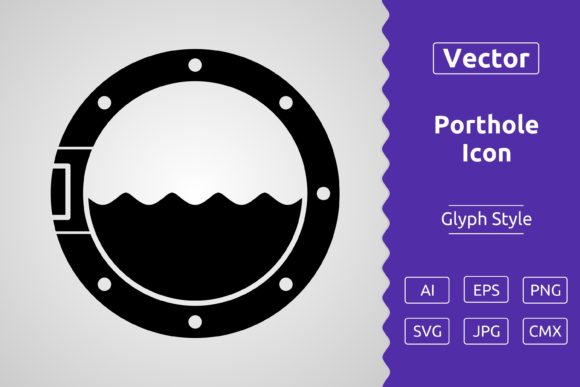
Vector Porthole Glyph Icon: Graphics & Icons for Evocative Branding
As a graphic designer who’s built brand identities for handmade studios, local festivals, and Etsy-based product lines over the past 12 years, I opened Vector Porthole Glyph Icon expecting something decorative—but what landed in my workspace felt quietly intentional. It’s not just another ornamental glyph; it carries the quiet gravitas of a nautical compass rose fused with the symmetry of a vintage telescope lens. The clean vector linework, balanced negative space, and subtle curvature suggest both exploration and focus—ideal for brands that want to evoke curiosity, craftsmanship, or gentle nostalgia without tipping into cliché.
A Mood That Anchors, Not Distracts
This isn’t a loud icon—it’s a grounding one. In a recent client project for a small-batch herbal apothecary launching a “Botanical Voyages” seasonal collection, I tested Vector Porthole Glyph Icon as a unifying motif across packaging labels, Instagram story highlights, and printable wall art for their brick-and-mortar pop-up. Its circular rhythm echoed the shape of glass apothecary jars and dried botanical specimens, while its restrained detail kept the visual language cohesive—not competing with hand-lettered type or soft photography. It worked especially well as a subtle watermark on product mockups and as a focal point on minimalist tote bag designs.
Where It Shines in Real Client Work
- Logo design & brand identity: Scales beautifully from favicon size (when simplified) to large-scale signage—especially when paired with serif or display fonts that share its sense of craft and intentionality.
- Packaging design: Adds tactile sophistication to kraft paper labels, sticker seals, and box debossing—its vector precision ensures crisp reproduction whether printed via flexo or digital press.
- Social media graphics: Performs strongly in Pinterest pins and Instagram carousels where circular motifs naturally guide the eye. Works particularly well as a frame for product photos or quote overlays.
- Cricut projects & printable design: The included SVG and PNG with transparent background make it plug-and-play for vinyl cutting, sublimation design, and layered scrapbook-style printable wall art.
- Editorial & web design: Functions elegantly as a section divider, navigation marker, or hover state icon—especially in blogs or landing pages focused on travel, wellness, education, or artisanal storytelling.
Contexts That Demand Extra Scrutiny
While versatile, Vector Porthole Glyph Icon isn’t universally frictionless. Avoid using it at under 24px in UI interfaces—fine inner strokes begin to collapse. On complex backgrounds (e.g., textured photos or busy patterns), its delicate geometry can visually recede unless given a subtle drop shadow or solid color overlay. It also doesn’t pair cleanly with ultra-minimalist corporate branding—think fintech or legal services—where geometric neutrality or sharp angularity is preferred. Likewise, in high-contrast black-and-white applications (like laser-engraved wood signs), test how the inner line weight holds up before finalizing production files.
Designer Notes You’ll Actually Use
- Test contrast early: Preview the PNG and SVG on both light and dark backgrounds—especially if your client uses dark-mode websites or Instagram story templates.
- Check transparency rigorously: Zoom in on the PNG file—some versions include faint anti-aliasing halos. If used for cut vinyl or Cricut projects, isolate and re-export the SVG path to ensure clean edges.
- Verify vector editability: Open the .AI and .EPS files in Illustrator—confirm anchor points are smooth and grouped logically. This matters if you need to adjust stroke weight for t-shirt design or resize for mug wrap mockups.
- Match typography deliberately: It harmonizes with serif fonts like Playfair Display or Merriweather (for heritage feel), rounded sans serifs like Quicksand (for approachability), and even restrained script fonts—but avoid pairing with overly ornate or condensed typefaces that compete for attention.
- Confirm commercial licensing: Before adding it to an Etsy product listing or print-on-demand store, verify the license explicitly permits resale in derivative works—many creative marketplace assets restrict use in POD unless upgraded.
Why It Earns a Spot in My Design Bundle Rotation
In the last six months alone, I’ve deployed Vector Porthole Glyph Icon across three distinct client categories: a coastal-themed stationery line (as a foil-stamped seal on letterpress cards), a boutique podcast branding package (as an animated SVG intro element), and a set of Canva templates for wedding planners (as a decorative divider between service sections). Each time, it elevated the work—not by shouting, but by lending quiet cohesion. It supports storytelling without overshadowing content. It feels handmade but professionally rendered. And crucially, the Download File Detail Zip File Included—with its .AI, .EPS, .SVG, and high-res PNG with transparent background—means no last-minute format scrambling before a client deadline.
Final Judgment for Creative Professionals
If your next project calls for a graphic design asset that bridges modern design and timeless resonance—whether you’re crafting a logo for a small business branding effort, building social media graphics for a seasonal campaign, or assembling a printable design bundle for digital sellers—Vector Porthole Glyph Icon is worth evaluating seriously. It’s not flashy, but it’s reliable. Not trendy, but quietly current. And in real-world client work, reliability and resonance are the two traits that keep designers hired—and brands remembered.