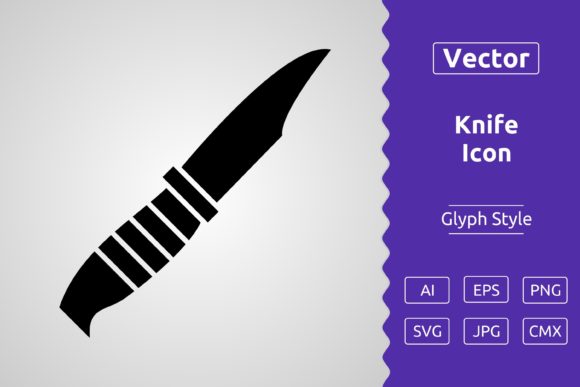
Vector Knife Glyph Icon: Premium Graphics & Icons
First Impression: Sharp, Crafted, and Confident
Opening the Vector Knife Glyph Icon file set, I immediately noticed its clean geometry and intentional weight distribution — not aggressive, but purposeful. It reads as a tool of precision: think artisanal cheese knives, hand-forged kitchenware, or a chef’s signature blade etched into a boutique soap label. This isn’t cartoonish clipart or generic stock iconography. It carries quiet authority — elegant enough for a small-batch candle brand, grounded enough for a local butcher shop, and refined enough to sit beside serif typography on a premium food label. It suggests craftsmanship, authenticity, and tactile quality — ideal for handmade businesses, farm-to-table brands, and local makers who want their packaging to whisper “made with care,” not shout “mass-produced.”
Where It Lives Best: Real Local Business Use Cases
In my recent branding work for a Portland-based olive oil & vinegar tasting room, we used the Vector Knife Glyph Icon across three key touchpoints: as a subtle watermark on custom product labels, as a decorative divider in printed menu graphics, and as a focal element in Instagram carousel posts highlighting seasonal harvests. Its versatility shone — especially because the Download File Detail Zip File Included gave us full flexibility: the .AI and .EPS files allowed precise resizing for foil-stamped bottle tags; the .SVG scaled flawlessly for responsive web banners; and the transparent PNG anchored beautifully over textured paper backgrounds in printable thank-you cards.
- Product labels: Works exceptionally well as a secondary brand mark — paired with a minimalist logotype, it reinforces “hand-cut,” “small-batch,” or “artisan-prepared” without cluttering ingredient-heavy layouts.
- Packaging accents: Ideal for die-cut hang tags, belly bands on ceramic mugs, or embossed elements on kraft boxes — especially when layered behind a clear window or over natural fiber textures.
- Social media graphics: Scales cleanly for Instagram Stories and Pinterest pins; the SVG version retains crispness even when animated subtly in Canva templates.
- Seasonal campaign visuals: Paired with dried herbs, linen textures, or warm-toned photography, it adds cohesion to holiday gift sets or spring farmers’ market promotions.
- Boutique visuals: Used as a repeating motif in receipt tape, sticker sheets, or custom tissue paper — reinforcing brand identity without overwhelming the product itself.
What It Builds: Tangible Brand Value for Small Businesses
This graphic design asset doesn’t just decorate — it strengthens perception. When applied thoughtfully, the Vector Knife Glyph Icon contributes directly to small business branding outcomes: sharper visual hierarchy on crowded retail shelves, improved customer trust through consistent, professional packaging design, and stronger emotional connection via symbolic resonance (a knife implies preparation, care, transformation — perfect for food, skincare, or home goods). For a local florist launching a “Farm & Forge” bouquet line, it helped unify digital ads, printed price lists, and reusable cotton tote bags — turning fragmented marketing visuals into a cohesive brand identity.
Where to Proceed Thoughtfully
Like any strong visual element, the Vector Knife Glyph Icon demands context-aware application. Avoid using it in formal corporate branding where neutrality is required — it’s too expressive for law firms or financial advisors. Steer clear on very small labels (under 0.5” height) unless you’ve tested print output — fine details may blur. Don’t place it over low-contrast backgrounds (e.g., light gray on white) without verifying legibility in both digital and physical mockups. And resist cramming it into ingredient-dense layouts or legal disclaimers — it competes with critical information rather than supporting it. Luxury minimalist brands should also test it alongside ultra-thin typefaces; its inherent weight may clash with extreme restraint.
Practical Designer Notes You’ll Actually Use
Before committing to client work, I always run these checks with assets like the Vector Knife Glyph Icon:
- Test it on real packaging mockups — especially curved surfaces like jars or tapered boxes.
- Convert to grayscale and preview on black-and-white printouts — does it retain clarity and presence?
- Scale it down to 8mm height and check readability on actual product labels.
- Overlay it against all brand color variants — does it hold contrast in both light and dark modes?
- Compare it side-by-side with competitor packaging — does it differentiate, or blend in?
- Verify print quality at 300dpi from the .EPS or .AI source — no pixelation in foil stamping or spot UV.
- Inspect the PNG transparency — no haloing or anti-aliasing artifacts against deep backgrounds.
- Open the SVG in Illustrator — confirm anchor points are clean and editable for minor tweaks (e.g., adjusting stroke weight for a specific label size).
- Test it beside serif, sans serif, script, handwritten, and display fonts — does it harmonize or visually fight?
- Confirm commercial licensing covers physical product sales — essential for handmade businesses selling branded merchandise or packaged goods.
A Strategic Graphic Design Asset — Not Just Decoration
The Vector Knife Glyph Icon is more than clipart or illustration — it’s a functional piece of commercial design. When embedded into a broader brand system, it elevates product mockup realism, strengthens marketing visuals, and adds tactile credibility to printable design and digital product assets. For creative entrepreneurs building local business equity — whether launching a candle line, rebranding a neighborhood café, or designing labels for a craft kombucha brand — this icon delivers precision, personality, and practicality. Used intentionally, it becomes part of the story your customers see, touch, and remember.